By: Amy Kesling, Cofounder of Step Up: Equity Matters
In the summer of 2020, after the murder of George Floyd and ensuing social unrest, dozens of organizations were contacting Step Up: Equity Matters asking for help to start or restart their efforts in diversity, equity, and inclusion. We knew it would take time and commitment to make these efforts sustainable, so we responded with dozens of proposals for 3-year engagements that covered training, assessment, planning, and implementation.
Willy Street Co-op was the first to sign on. This wasn’t their first go at DEI; they had spent the previous few years self-organizing, participating in some of our first Step Up workshops in 2014, pursuing cultural competency certification, and completing self assessments and internal training. But none of it seemed to stick. As I interviewed leaders, managers, and staff, I sensed a deep skepticism about whether the organization would bring the level of commitment and accountability needed to make real change happen, especially amidst the havoc the covid pandemic wrought on the grocery industry and navigating a newly established relationship with a workers’ union.
Fast forward to 2025: The Co-op has made significant, measurable progress in many aspects of diversity, equity, and inclusion and our partnership is still going strong.
Taking root
After initial in-depth equity training and coaching with the management team and an organizational DEI assessment, we set out to co-create a DEI strategy that would reach across the organization—five sites, 375+ employees, and hundreds of vendors. The planning work culminated in the creation of a DEI oversight committee plus three working groups: Owner & Community Engagement, Retail & Supply Chain Strategy, and Employee Engagement & Development.
The strategy laid out goals for each of the groups, initiatives to work toward those goals, and metrics for measuring success.
Examining gaps
You know the saying, “you can’t manage what you don’t measure?” While this is true, it doesn’t provide much guidance on what is worth measuring. It’s one thing to measure customer experience. It’s another thing to measure experiences of Black, Indigenous & People of Color (BIPOC) customers and compare it to the overall measure. The Co-op, like many organizations, found that they had gaps: compared to overall staff, vendors, and shoppers, BIPOC staff had lower employment rates, vendors brought in less revenue, and shoppers reported less positive experiences in the stores.
Over the last five years, we’ve seen many of those gaps closing.
In 2023 and 2025, the biannual Owner Survey has included the question: How well does the Co-op prioritize DEI? In 2023, BIPOC respondents were 18 percentage points less likely than the overall response group to respond with “Very Well” or “Well.” In 2025, that gap narrowed to eight percentage points.
Because we added more in-depth demographic questions, we were also able to get a better understanding of different priorities based on race/ethnicity, primary store visited, and other demographics. For example, we now know that BIPOC respondents are more likely than the overall response group to prioritize supporting local, sustainable agriculture and development of small, local businesses.
Employee racial and ethnic representation gaps are also closing. Since 2021, the overall employee population has come closer to representing the racial and ethnic composition of Madison overall, though employees identifying as white are still overrepresented.
In 2023, sales from local Inclusive Trade brands made up 2% of total sales. In 2025, that number increased to 2.5%.
On the ground
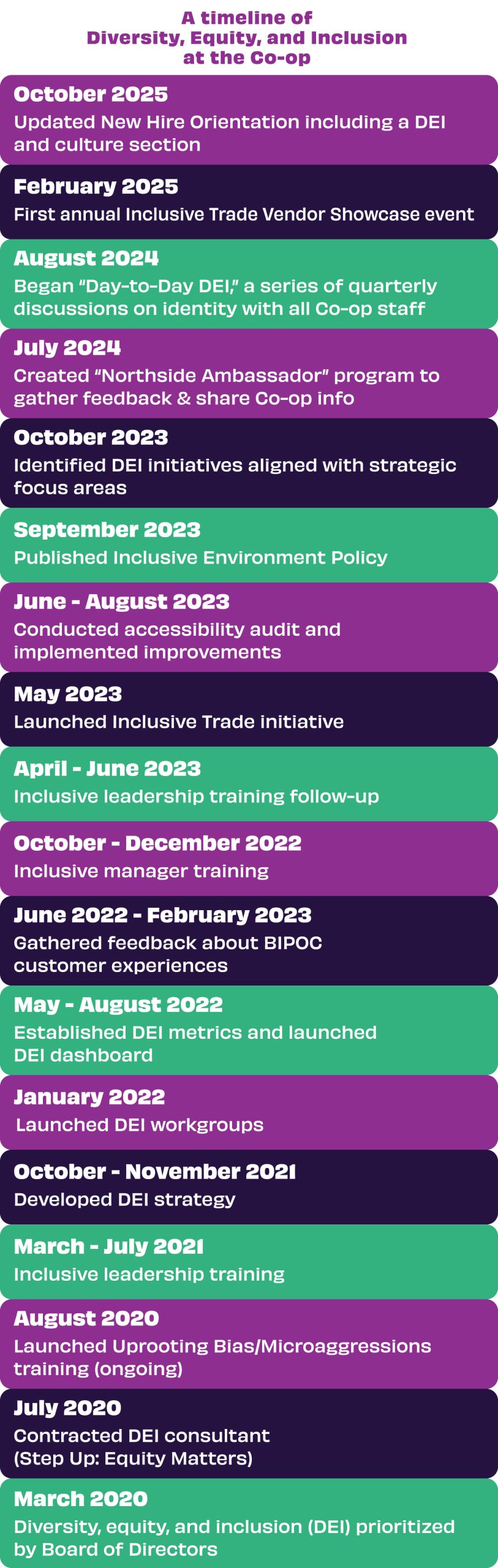
How is the Co-op working on closing these gaps? Since 2022, each DEI work group has identified initiatives to make a positive impact. Some are standalone programs, like Day to Day DEI. Others reflect changes to existing programs and processes to better embed equity, like streamlining the vendor application process to remove unnecessary barriers.
Here are some of the initiatives:
- Launched and maintained a public-facing DEI Dashboard to transparently communicate progress and setbacks
- Launched and expanded the Inclusive Trade program to better support and promote brands owned by people from underrepresented groups
- Launched Day to Day DEI, a quarterly education program for managers and staff to engage in conversations about specific identity groups and their experiences
- Refocused Owner Survey to better understand differences in Owner experience and priorities based on demographics
- Established and deepened northside community relationships to further embed the Co-op into the community surrounding its newest retail location
- Completed Access to Independence accessibility assessment and made updates to signage, physical spaces, and more
- Updated brand identity philosophy to better capture the breadth of product priorities
- Updated vendor application process to remove unnecessary barriers
- Created Inclusive Environment Policy to establish shared expectations of staff, shoppers, and vendors at the Co-op
- Hosted employee engagement events
- Conducted a variety of DEI-focused staff and manager training and coaching
You can learn more about many of these initiatives and track the Co-op’s progress at willystreet.coop/dei.
Lessons learned
Not all of our initiatives were successful and, even where there has been success, the Co-op still has a long road ahead to continue closing identity-related gaps.
Engaging staff and community members has been a slow process. At first, the leaders of the DEI initiatives felt wary – the “what-if monster” ruled. What if our ideas don’t make a difference? What if people think it’s all talk, no action? What if we somehow make things worse? What if we ask what people need from us and we can’t fulfill it?
So the work got started carefully and, for the most part, quietly. We worked on building and recalibrating internal systems to better support the DEI goals, including building out an HR function that could adequately support the organization’s growth, examining and updating vendor processes, and establishing baseline data.
This approach ultimately proved more sustainable – when you embed a DEI lens into existing and growing systems and processes, it’s more likely to be taken seriously – but it also meant that the Co-op’s progress wasn’t obvious to most people. Even this past summer, after three and a half years in the implementation phase, many managers were surprised to learn that so much work had been underway.
Now, the Day to Day DEI program and other changes in internal communication and collaboration processes help more staff and managers stay aware and get involved in DEI efforts.
Logistical constraints have also been challenging. When the Retail & Supply Chain work group initially rolled out the Inclusive Trade program, we didn’t factor in the amount of time, equipment, and collaboration it would take to get new signs and labels printed in the stores. On top of that, National Cooperative Grocers, the association that provides support for the Inclusive Trade program, provides updated brand lists every quarter that reflect changes in brands carried by national distributors, meaning that the number of Inclusive Trade-qualifying brands changes quarterly, making tracking difficult.
To ease the stress of this, the group decided to focus their expansion initiatives on brands that are both Inclusive Trade and local. This is a more consistent metric to track and emphasizes the Co-op’s commitment to investing in Madison’s local economy.
What’s working?
Step Up has worked with dozens of organizations on embedding inclusive and equitable practices into their strategy, operations, and culture. The Co-op has taken a unique and impactful approach in several ways: deep leadership buy-in, consistent focus, and engaging in active accountability.
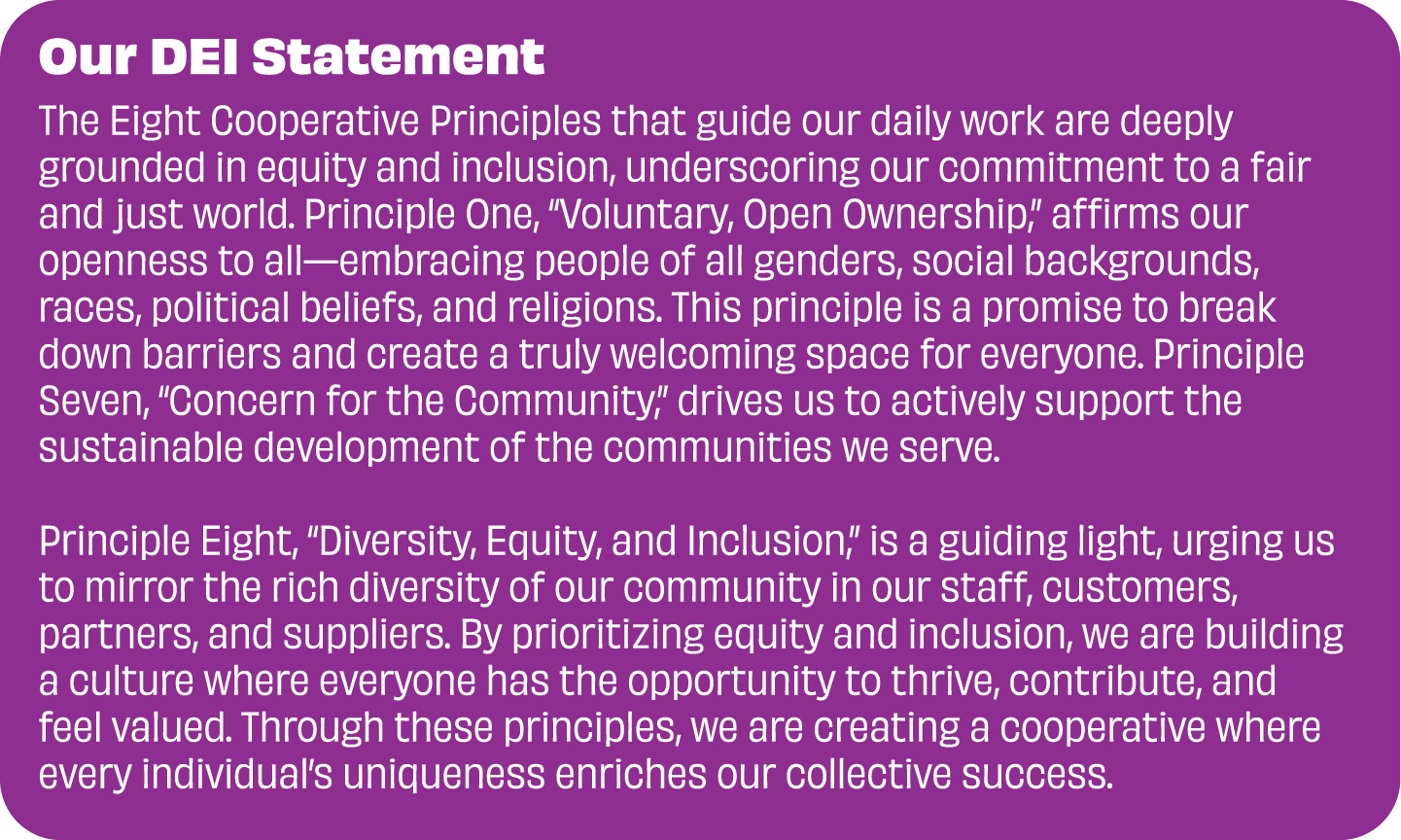
From the start of our work together, the Co-op’s entire general management (GM) team, including directors from all sites and function areas, has been deeply engaged in setting the direction and following through on the execution of the diversity, equity, and inclusion strategy. Every member of the GM team is actively involved with at least one of the DEI work groups, participates in regular strategy sessions, and leads their site or team’s Day to Day DEI discussions. These responsibilities are written into their job descriptions and part of their performance feedback process. Additionally, the DEI Committee includes board representation to ensure alignment with governance practices and incorporate community perspectives. Because of this structure and buy-in, the strategy and initiatives are designed more effectively and have survived turnover of leadership positions.
Consistency has also been key to the Co-op’s progress. There is an established schedule of meetings and reporting to ensure measured, consistent progress. The annual DEI plans take into account the organization’s busier seasons, creating realistic timelines and expectations. The work is steady and purposeful, not an intense rush to check all the boxes.
Ultimately, leadership buy-in and consistency have set the conditions for an active approach to accountability. The board and leadership monitor the efforts and outcomes. Staff, vendors, and community members are invited to monitor progress via the public DEI dashboard (willystreet.coop/dei). The Co-op’s ongoing partnership with Step Up provides an additional level of accountability. We hold leadership and work groups accountable for adhering to the plans and providing subject matter expertise to guide effective, equitable decision-making.
On the horizon
As we look ahead in our partnership with the Willy Street Co-op, the journey toward equity and inclusion is far from over—but the foundation is strong. The progress made over the past five years demonstrates what’s possible when an organization commits to sustained, collaborative DEI work rooted in accountability and transparency. The Co-op’s willingness to learn, adapt, and keep equity at the center of its strategy has closed gaps and set the stage for a more inclusive environment for staff, vendors, and shoppers alike. Moving forward, the Co-op will continue to build on these successes, deepen community relationships, and refine its practices to ensure that diversity, equity, and inclusion remain integral to its mission and daily operations.
Learn More at: www.willystreet.coop/about/diversity-equity-inclusion-at-willy-street-co-op/