By: Andy Gricevich
HAPPY ANNIVERSARY, PARKS!
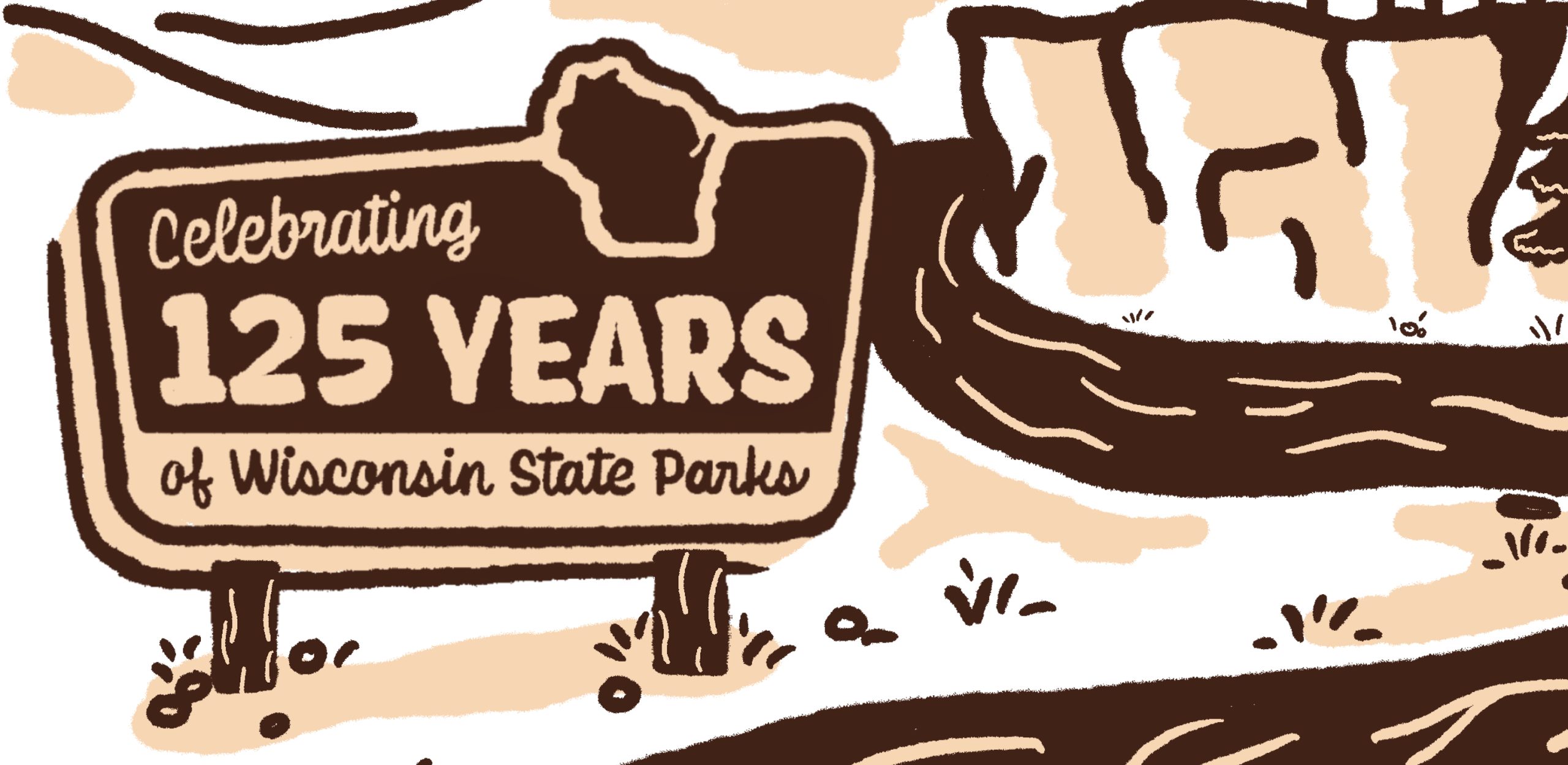
This year marks the 125th anniversary of the Wisconsin State Parks system, and we’re here together in this article to celebrate not only the fantastic sites of the State Parks, but also our County and City Park systems. We’re so fortunate in our region to have access to so many incredible outdoor spaces!
If you live in Wisconsin (or are a seasonal traveler from the Chicago suburbs), you may well already have an attachment to some of the places mentioned here.You may have visited the northern extreme of the state, and fallen in love with the parks in the Great Lakes region, like the Apostle Islands, or gone up to any part of the Chequamegon-Nicolet State Forest. Perhaps you’ve visited places like Kohler-Andrae State Park, with its gorgeous dunes along the shore of Lake Michigan, or been to Wyalusing State Park, at the confluence of the Wisconsin and Mississippi Rivers.
Closer to home, you may have ventured to Devil’s Lake, with its incredible scenic hikes along stony blufftops, gigantic rocks to clamber upon, and great swimming when the day is done. Blue Mound State Park also offers incredible views of the surrounding countryside, as well as the glorious rises and falls in the landscape that begin as we enter the Wisconsin Driftless area. Then there’s Governor Dodge State Park, locally famous especially for its waterfall-fed pond and its clean swimming and fishing lakes. It’s also full of forest, prairie, and wetland areas for all kinds of exploration, as well as dedicated trails for the equestrians among us; for those who aren’t, you’ll notice plenty of traces of horses to step over.
Even closer (Madisonians) you’ll find Donald County Park, with its large springs and pristine streams (adored by waders, trout-fishers, and gatherers of watercress), its lovely and leech-ridden pond, its old apple orchards, and its lofty, rocky summit—glorious on a clear day, and beautifully terrifying in a thunderstorm. Within the city itself, we have a huge number of fantastic parks and conservation areas. One of the gems here is Hoyt Park, located on the near west side of town. Dedicated volunteers (and a couple of rangers, one of whom might just be writing this article) have been working hard to restore Hoyt to an oak savanna environment that sustains a wide diversity of plant and animal life.
THANKS TO OUR PARKS DEPARTMENTS
Wisconsin features 50 state parks, 15 state forests, and 44 state trails. The statewide parks system was formally founded in 1900, and John Nolen (who Madisonians know primarily from the big road that runs along the lake near our Capitol) had a major hand in sketching out the plan for the preservation of our natural spaces for the public. The first official site was Interstate Park, along the St. Croix River. Devil’s Lake was one of the next to follow, and our state has kept the ball rolling ever since—establishing many areas for outdoor exploration, camping, and lots of other opportunities.
This year, our state is organizing
a huge number of events to commemorate the anniversary of the Parks system—everything from pulling invasive species to birding outings to canoe trips, guided wildflower explorations, classes with experts on reptiles, and more loosely structured hikes. You can see what’s coming up at dnr.wisconsin.gov/events. When you CHIP at the Willy Street Co-op registers, a percentage of your donation will go to the Friends of Wisconsin State Parks to help fund these events.
…AND THANKS TO OUR VOLUNTEERS
While the Department of Natural Resources and our local Parks departments are essential for the establishment and maintenance of our parks, Friends groups are also crucial. Though public funding for parks in Wisconsin is very strong, relative to many states,
a lot gets done by volunteers, who meet for work days, raise funds, help host events, and educate the public about the history and ecology of our natural spaces. Volunteers have been working hard for decades in the parks (and in other places, like the countless units of the Ice Age Trail) to restore native habitats, build trails, and establish places for us to hike, camp, and experience the natural wonders around us.
In Madison itself, many parks and conservation areas have benefitted from that kind of care, and, all over, we’re seeing a resurgence of owls, fox dens, delicious wild berries, and so much more. There’s an encouraging overall trend at city, county, and state levels
toward getting back to traditional methods of ecological preservation
and restoration. Those include controlled burning of prairies and spacious woodlands—managed fires that can reduce invasive species and increase soil fertility—as well as bringing sheep and goats onto parklands, where they munch on undesirable shrubs, leaving more room for a diversity of native plants, and a less prickly and tangled environment for park visitors. Statewide, we’re seeing a lot of creativity and knowledge in action from the professionals and volunteers who take care
of our Parks systems.
 WHY WISCONSINITES LOVE OUR PARKS
There’s so much to exult in here! We live in an incredible landscape, sculpted by glaciers and the dynamics of our inland seas, and it’s easy to find an amazing spot, wherever you are. Even
if you don’t have the time to drive hours north to the Superior shore, we have the Baraboo hills nearby (less than an hour out of Madison), which feature not only Devil’s Lake, but countless other state parks and natural areas.
Heading east toward Milwaukee, we have Aztalan State Park, home to some of the oldest-known earthworks built by indigenous people before European settlement. Azatlan was connected with other pre-settlement communities extending down as far as central Mexico, and is a great place to get a sense of that deep history.
In another direction, Ferry Bluff State Natural Area offers glorious views of the Wisconsin River, as well as bald eagle nests and other treasures. You might also pass it if you take a boat from Sauk City all the way down the river—maybe camping on the sandy islands in the middle of the Wisconsin—and hike up to the lofty heights
at Wyalusing.
Closer to Madison, you can rent a canoe and/or campsite at Lake Kegonsa State Park, and have a great day on the water and in the woods. Rutabaga Outdoor Adventures in Monona offers both structured explorations on the water, and also boats you can just take out—maybe as far as Lake Farm County Park, a relatively neglected place full of a variety of shorelines, trails, wildlife and plants, as well as great recreational sites for gatherings of all kinds.
GATHER YOUR FOOD
Another great way to connect with any of these spaces is through foraging. So many of us have gotten hooked on life in the outdoors through running around and picking berries (or, speaking of getting hooked, through fishing). If you’re out with kids, and they’re gathering food from the wild, you’ll see that many of them will eat many more plants than they’d ordinarily touch—and that might be the same for you as well!
It’s good to know the rules; in the state parks, you can harvest any fruit, nuts, or mushrooms, as well as anything that’s considered bothersome (like garlic mustard and watercress). Friends groups and rangers may even be happy for you to gather those problematic plants—as when a ranger encouraged my young son and I to harvest prickly ash leaves and fruits.
The only native citrus family plant in our region, prickly ash is a close relative of Szechuan peppercorn. Because it’s extremely thorny and thicket-forming, people don’t usually want the plant around. Like Szechuan peppercorn, it also numbs the mouth (and has been employed traditionally to treat toothache). My son and I loved it enough to eat a ton of it, and we had a messy, but happy, drive home.
Generally, we’re not allowed to take leafy plant material in the State parks, while County park rules are more variable. The City parks in Madison allow gathering pretty much anything, as long as you’re not digging up a plant. Responsible foragers also don’t gather anything from park lands for resale, which would amount to taking public property and charging the public for it.
If you’re interested in wild food in Wisconsin, there are a lot of resources. Relatively near Madison, What Got Gathered, Eagle Outdoor Skills, Fire and Foraging, and Color in the Outdoors all give foraging walks. Linda Conroy is a local standby and a fabulous teacher, and will give a walk via your Co-op in August! A few hours north, Forager’s Harvest is probably the best place in the nation to go for that kind of knowledge.
Probably the best tips—if you want to get started with wild food, but aren’t yet ready to take a deep dive—are:
- If a fruit looks like a raspberry or blackberry (made of all those little balls), you can eat it.
- If a plant has a square stem, and smells like something you would clearly be fine with eating, it’s in the mint family, and you can eat it.
- If a plant smells strongly like onion or garlic, you can eat it.
The berry tip, in all honesty, is probably the only one most people will need—but it’s the tip of an iceberg!
OUTDOOR TIME FOR BETTER LIVING AND LEARNING
Weslie Cymerman runs OWL (Outdoors We Learn). She’s been a schoolteacher, a wellness & PE teacher, camp counselor, and much more. She’s landed on outdoor education as something she finds essential for both kids and adults, and I recently had the opportunity to talk with her about her journey toward making that her central focus.
Cymerman points to the difference between the ways kids behave indoors in classrooms, throwing buckets of pencils in the air, distracted and indifferent, and the same kids grabbing a couple of acorns or leaves and tossing them around outside—and then having much more focused energy throughout the day. She thinks there’s at most a marginal increase in labor-time for educators, and with much improved
results—in terms of education and child development—when things move
outdoors.
That’s why Cymerman repeatedly speaks to the Madison School Superintendent’s Board about the importance of more outdoor time for kids, whether it involves longer recesses for simply running around and working off energy, or if it includes gardening and eating plants the children helped grow themselves. Cymerman points to how much easier it seems to put kids on a screen than to get them outdoors and supervise them, but she insists that it’s worth the little bit of extra effort.
For example, she notes that some of our public school students have been studying birds in their classrooms, but why don’t they go out to spend time with the birds directly? That wouldn’t be too hard to arrange at most schools, and could be part of science classes,
and many other parts of an educational curriculum. Things could go beyond that, though: sunshine and fresh air generally wake our minds up, and can help make a beneficial environment for any form of learning. There’s not any necessary contradiction between walking on a log or a balance beam and sitting down outside to work out equations and take notes on history.
SEE YOU OUT THERE!
Our public lands—from school grounds to City, County, and State Parks—offer endless opportunities for recreation, exercise, connection to nature, and overall well-being and enjoyment. Although Cymerman talks specifically about working with kids, her concepts apply to every one of us, and we can all benefit from taking advantage of the outdoor spaces to which we have access.
We’re all still those kids! In a human-engineered world which can so often feel overwhelming, time in nature provides so much support for our bodies, minds, and emotions. The State Parks, in particular, give us large and grand outdoor spaces in which we can find space to connect with more natural rhythms, and with the incredible landscapes we have here in Wisconsin. Here’s to the 125th anniversary of the Parks!
For more information about these organizations, go to:
www.dnr.wisconsin.gov/topic/parks/125years
www.outdoorswelearnmadison.com/
www.willystreet.coop/event/late-summer-wild-food-wild-medicine-plant-walk/