 By: Nick Heitman, Meat, Seafood, Beer, Wine & Spirits Category Manager
October is Sustainable Seafood Month, and with it comes the opportunity to highlight some of the brands and products that the Co-op works with and supports whose fishing or farming practices are in line with our core values. The seafood industry as a whole has certainly faced some deserved criticism in the past due to overfishing, unmitigated bycatch, unethical farming practices, and unfair labor or human rights violations. We strive to partner with suppliers and brands who share our mission of transparency and environmental sustainability.
There are three organizations within the seafood industry that provide information that distributors and retailers (including the Co-op) utilize when sourcing wild and farmed seafood. The Marine Stewardship Council (MSC) is a global non-profit organization whose focus is to eliminate over-fishing. They also work to eliminate seafood fraud, such as the mislabeling or misrepresentation of products. You’ll find their label on many products at the Co-op, including frozen fish fillets and canned tuna.
Monterey Bay Aquarium has great resources to help make sourcing decisions for both wild-caught and farmed seafood. Their Seafood Watch tool makes identifying sustainable sources of various species easy, and is the main tool that the Co-op uses when identifying whether we’d like to make a product a part of our offerings. We strive to only offer products that have a green or yellow rating, and our distributors follow the same practice.
The third resource whose labels you’ll find on products at the Co-op is Best Aquaculture Practices (BAP). This organization specifically audits and certifies aquaculture suppliers, or farmed seafood. They monitor all aspects of aquaculture including hatcheries, farm location, and its environmental impact on native species, animal welfare, feed, harvest and processing, and labor practices. You’ll find their labels on many products in our seafood freezers, including frozen shrimp, fish fillets, and breaded seafood.
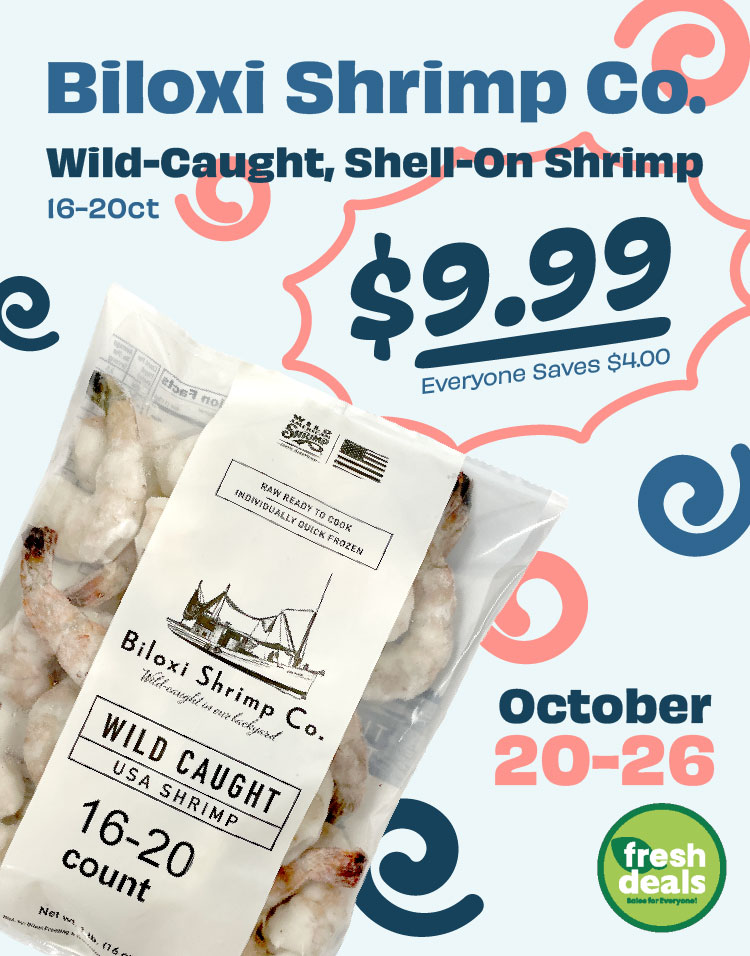
While our offerings tend to vary slightly from store to store, there are a couple “core” items that are available year-round that are responsibly sourced from either a wild fishery or aquaculture farm. Niceland Icelandic cod loins are offered at all three Co-op locations, and are some of the most environmentally sustainable and responsibly-sourced wild seafood available. Certified sustainable by the MSC, the packaging on this fish includes a QR code that allows the purchaser to trace the fish through the supply chain. This level of transparency and traceability, on top of the quality and consistency, makes it a top choice for anyone looking for a great protein option. Another great option available at all stores is Biloxi Shrimp Company’s Gulf shrimp. Wild-caught off the Gulf Coast of the U.S. and processed in Mississippi, these are some of the best-tasting and responsibly caught domestic shrimp available. Look for one-pound bags in various sizes in the freezer section.
Working with distributors who share similar values to the Co-op makes the daunting task of sourcing ethically sourced products much easier. I was able to send some questions to Tim Berc, Vice President of Procurement for The Fish Guys/Markethouse Meats in St. Paul, MN, to get his insight on how procurement works on a larger scale:
Nick: Can you describe your role with The Fish Guys/Markethouse Meats?
Tim: Procurement, with a focus on Fish/Seafood/Specialty. I’m responsible in large part for the thoughtful selection, curation, and development of our Fresh and Frozen programs; to include purchasing, supplier/processor relationships and vetting, sales/customer education and training, supply chain and logistics management, and general overall category strategy. Which in short, really just means my role is “passionate foodie with a bit of stress/adrenaline junkie thrown in for good measure.” I love it.
Nick: How does sustainability impact your procurement process?
Tim: At the Fish Guys, we have always been driven to offer an elevated selection of products—we feel it is our obligation to keep quality, service-level, and transparency at the core of everything we do. Sustainability has long been an important part of our strategy and belief system, far prior to it being so well (and thankfully!) embraced by today’s larger audience. It has been very gratifying to see and be part of this positive evolution over time, as the awareness and recognized importance of sustainability has become more of a priority in our daily lives. It used to be a much larger challenge in our industry to find like-minded individuals throughout the chain—from fishermen and aquaculture farmers, to processors, producers, and logistics providers—but these days, finding folks with similar values to partner with, has become easier on many fronts. One of the standard requirements of our ongoing evaluation process for any existing or potential supplier partners, is to ensure that they are doing things “right” from a sustainability standpoint—human, animal, and environmental welfare as core priorities of their organizations and processes throughout.
Nick: What are some “red flags” in the seafood industry that you encounter when working with fisheries or farms?
Tim: Although it continues to occur less and less, there are certainly still some bad actors in the food business overall—cutting corners or sweeping things under the rug in the interest of inflated profits or convenience, or both. As it relates to the Fish and Seafood industry: illegal, unreported, or unregulated fishing/catch; use of undeclared or banned substances/chemicals in fish processing or feed; over-stocking; over-harvesting or underreported mortalities in aquaculture; poor fishing or farming methods resulting in environmental damage or protected species mortality; or violation of human rights/welfare, to name a few. Our industry has significantly moved the needle over the last couple of decades in utilizing technology and science to better regulate, manage, and police fishing quotas, incidental bycatch, damage to the environment from fishing or aquaculture, etc. while increased awareness, identification, and exposure of the bad actors has helped shine a well-deserved light on the organizations that are truly doing things right. A rising tide lifts all boats, so to speak, increasing the number of organizations that are motivated to be part of the solution.
Nick: Aquaculture has received plenty of negative feedback in recent years. What are some aspects of seafood-farming that have a positive impact on sustainability that people may not realize?
Tim: So, let’s face it—regardless of improved technology, monitoring, and regulation, there will come a time in the not-too-distant future, where we will need to depend on aquaculture more and more as our global wild fishery catch becomes less and less abundant. Climate change creating harsher fishing conditions and unchartable species migration, ever increasing world populations and consumption, a growing number of fishers aging out of the often and increasingly perilous profession of open ocean fishing with fewer younger generation fishers replacing them, etc. all lead to growing challenges with wild fishing. Increased amounts of aquaculture presence and consumption is already helping slow this inevitable progression in the wild sector—I think the old way of thought that carried with it a stigma of poor or unclean farming practices, high levels of farmed fish escapement jeopardizing wild fishery stocks, competitive barriers to wild fishing due to cheaper farmed species, etc., is largely in the rear-view mirror. As a matter of fact, due to the increasing amount of technology, vertically integrated farming organizations, better animal welfare practices, reduction of chemical use, and higher acceptance of aquaculture in general—many farmed fish options have risen to similar or higher price levels than wild. Believe it or not, beyond the historical staple items like farmed tilapia, salmon, shrimp, and rainbow trout, there are now many amazing farm operations throughout the world rearing sought after items like halibut, cod, sole, scallops, a variety of different sea bass options, tuna, the list continues to grow! The aquaculture and wild sectors have become more collaborative and complimentary over the years, out of necessity and wider acceptance, in my opinion. More and more land-based, recirculating aquaculture systems are coming into play as well—all which tout even higher levels of increasing sustainability in terms of environmental and animal welfare, reduced carbon footprint, clean water containment and reuse, reduction in ocean pollution and seabed activity, etc. The future health of our ocean stocks and our access to the widest variety of one of the most amazing proteins on Earth will depend on sustainable aquaculture.
Nick: How has the ongoing situation with tariffs affected your procurement decisions?
Tim: No mystery—tariffs have been a challenge and are making for a bit of a delicate situation. The uncertainty may be the toughest part to manage, particularly in the fish and seafood space, as the vast number of offerings in our category easily make fish and seafood the highest imported animal protein into the United States. Fish and seafood have also historically fallen into the category of “luxury” or specialty foods, and any resulting increased costs or reductions in availability can potentially push the perception of [these products being] less affordable to even higher levels if we’re not careful. The reality is that our current level of fish and seafood specifically farmed in or fished by the United States, is not nearly enough to meet the overall demand. Pivoting exclusively to U.S. fish and seafood as a hopeful solution would inevitably drive costs up on that already limited resource—potentially up to or beyond even, where some of the recent and/or not yet realized increased costs are heading. We continue to monitor and work to help mitigate as much of these cost increases as possible, while also trying to source items that are less affected and/or offer more minimal varieties of items that originate here, as needed. We intend to ride out the storm and be the best consultants we can be, to our retail and restaurant clients both. We continue to hope for resolution, but also continue to adjust the sails to accommodate a changing landscape.
 Seafood Glossary
- Wild-Caught: marine animals that are harvested in their natural habitat. This can include oceans, lakes, or rivers.
- Farm-Raised: marine animals that are raised in controlled environments such as ponds, tanks, or ocean enclosures. This farming method is also known as “aquaculture.”
- Sustainable Fishing: leaving enough fish in the ocean to replenish the population; fishing in a way that respects other species and marine habitats; and managing the fishery in a way that can adapt to changing environmental circumstances and ensure people who depend on fishing can maintain their livelihoods.
- Overfishing: overfishing occurs when the fishing rate is higher than the rate at which fish reproduce and repopulate or when there are not enough adult fish left to breed and maintain a healthy population.
- Bycatch: fish or other marine species caught unintentionally during the fishing process. Bycatch is a serious issue especially when endangered, threatened, and protected (ETP) species such as turtles and dolphins are accidentally caught, injured, or killed. Referred to as “unwanted catch” in the MSC program.
Learn More
- Marine Stewardship Council: https://www.msc.org/en-us
- Monterey Bay Aquarium’s Seafood Watch: https://www.seafoodwatch.org/recommendations
- Best Aquaculture Practices: https://www.bapcertification.org