By: Kristina Kuhaupt, Customer Experience Manager
From Challenge to Tradition: 15 Years of Eat Local Month
As we head into September and our 15th year of Eat Local Month, we reflect on how our personal yearly funds impact our local economy. Fifteen years filled with local community causes, vendors, farmers, and your support of our local cooperative business is definitely worth celebrating during our 50th anniversary year! Fun Fact: Did you know that Eat Local Month actually started out 15 years ago as an Eat Local Challenge? We challenged Co-op customers to switch as many of their grocery purchases to local versions as possible—whether purchased at our stores, at other stores, at farmers’ markets, or even in their own garden. As they searched for ingredients, some customers were surprised to find locally made options they didn’t know about, and some customers were dismayed to realize there were some categories with few or no locally made options (salt and acids like vinegar were frequently mentioned). We also heard about creative solutions, like using local plums to make a plum upside-down cake! (We still don’t have local pineapples, unfortunately.)
Local Investment, Real Impact
I think we all have a general understanding that if we invest in our communities through local, small businesses, the impact ripple is quite large. However, what does that broad concept even mean tangibly? Some specific ways at your Co-op include:
The Community Reinvestment Fund (CRF), established in 1992, has donated $673,500 to 436 local nonprofits and cooperatives specifically for single projects under $10,000. What started humbly with $2,000 and a dream to positively impact the community we serve has now grown into quite a well-established program that distributes $65,000 per year. This program supports educational, developmental, and community-driven projects. In 2025, the Board approved an additional new arm to this program for larger capital purchases/investments to support our local, sustainable food system for a total of $20,000. Rooted, Madison Area Food Pantry Gardens, and Madison Northside Planning Council’s FEED Kitchens were the first recipients of this pilot grant.
Additionally, the Co-op also contributed nearly $974,000 in Fiscal Year 2025 to local causes, like donations to nonprofit silent auctions and community festivals. Since 1990, the Co-op has collected more than $4.9 million in customer donations for the 70 local nonprofits under Community Shares of Wisconsin! WOW, that is extraordinary!
Investing in People: Supporting Local Workers, Farmers, and Community
In 2025, Willy Street Co-op is proud to employ 387 local workers (272 of them employed full-time as of this writing) on the east, north, and west sides of Madison/Middleton and serve our community of more than 34,000 active Co-op Owners. I know when I was first hired around three years ago, I was so grateful because I knew I would be with an organization that actually cared not only about how they fairly compensated their staff, but also the overall, everyday positive treatment and fair and equitable working practices. Although I am not part of our Union due to being a manager, many of my Customer Experience staff are, and we are very grateful for their partnership with our organization starting back in March of 2020. Your grocery dollars help support the livelihoods of all of us who work here, and we are very grateful to you for not only supporting local farmers, makers, and producers, but us as well. Without you, we would not have such a great place to work, both now and throughout the 50 years we have been in operation!
The Co-op’s three stores in Madison and Middleton continue to offer various products sourced from hundreds of local farmers, producers, and vendors, creating a growing, sustainable, local economy totalling $23,004,509 in sales to these businesses in Fiscal Year 2025 with an additional 15 new local vendors added to our lineup totaling over 450.
In 2024, Willy Street Co-op opened its newest venture, Aubergine, a commercial kitchen and community space available for rentals on the eastside, adding another facet to the Co-op’s mission of supporting community connection and growth. Since opening, Aubergine has hosted 150+ individual rentals that help support non-profit trainings, company retreats, family/friend gatherings, birthday parties, celebrations of life, and small business commercial kitchen rentals, 12 featured artist gallery exhibition nights, and approximately 100 cooking and wellness classes, all contributing to the overall wellness of our local community.
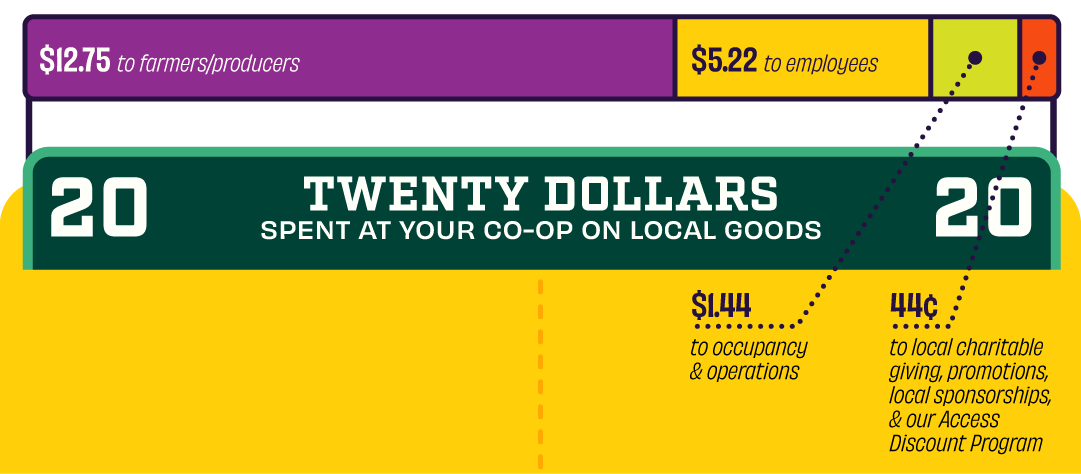
When You Shop Local, More Money Stays in the Community
To the left is a nice graphic that shows what $20 spent in our stores actually means in dollars and cents. Currently, for every $20 you spend on local products at the Co-op, about 92% of that money stays local.
Strong Local Ties = Steady Supply and Community Stability
During these uncertain times, shopping and supporting local are becoming even more imperative to preserve the fabric of our communities. Being an Owner means you are taking an active role in our community saying, “This is important to me, and I want to make sure it continues to stay around for generations to come.” We saw the limits of our supply chain during the pandemic, and there are warning signs of that strain again with the tariffs. Comparatively, the local production of food means a much shorter supply chain to better ensure resilience for our communities.
We saw this several months ago when egg prices skyrocketed everywhere else, but not at your local Co-op. Why was that? Rather than partnering with mass-produced egg facilities where disease can spread and affect a whole supply chain for the country, we work with a number of smaller, local egg vendors. This diversity in suppliers helps to ensure a consistent supply. Your Co-op will never drive up prices to match other chains if we are not experiencing the same effects! Yes, the Co-op can have some higher priced goods due to paying equitable wages to both our farmers and staff, in addition to not having the same buying power as very large national retailers; however, when we can pass down savings, like during the egg shortage, we will do so due to these strong local connections! This is a portion of what your equity is buying into—stable local networks for the long-term benefit of communities.
When Funding Falls Short, Community Can Step In
Speaking of uncertain times, I do want to take a moment to highlight all our local non-profits that are being slashed right now through the loss of grant funding. This has affected food/housing security, public broadcasting, museums, healthcare, and many other industries. I mentioned above all of the amazing donations you all have helped support in the past year, below are some of many organizations that could really use some financial as well as advocacy help these days.
On a personal note, my team and I facilitate all the donations you see mentioned above, which means we have great working relationships with all the people leading these organizations in our communities. It has been personally heartbreaking to see many of the people in our communities either lose their jobs or have to dramatically cut programs due to funds being dissolved. There have been more emails I have had to respond to than I would like to admit to saying, “I am so sorry to hear….” Point being, Co-op Owners are change-makers by nature, and I want to provide the names of some of these great local organizations we work with if you’d also like to support them monetarily, by volunteering, or otherwise. Although I can’t list every organization we have the privilege of working with, let me start with the following: New Bridge, Madison Children’s Museum, Community Action Coalition for South Central WI, River Food Pantry, Goodman Community Center, Wil-Mar Community Center, Lussier Community Center, WayForward Resources, PBS Wisconsin, Community Shares of Wisconsin, and FoodWIse.
What Value Means at the Co-op—And Why It Matters
As we celebrate our 15th Eat Local Month, ultimately, it points to the concept of value. What is value? It can be the monetary worth of something, but it can also be the intrinsic desirable worth we place on that same thing. I truly believe that Co-op is a high-value entity in our community that helps to fulfill the ever-changing needs of both our community and the individuals within it.
You all prove that to be true in the feedback you give us through many different channels: customer comments, register surveys, biennial Owner surveys, and social media reviews. Over the past 12 months (when writing this article) around 3,695 people took our daily randomized register survey, and results show that our averaged 12 month satisfaction rate is 76%, Likelihood to Return to our stores is 83%, Likelihood to Recommend is 74%, and Felt Welcome was 97%. Those numbers put an intrinsic value on our organization, along with the hundred comments we get every year thanking us for our deeply rooted values. I will leave you with a few below and thank you for partnering with us all these years, through the thick and thin of life—we appreciate you!
“Love being involved with a local coop. The staff is always so very helpful and friendly. Generally always find what I am after. Love supporting local products. Coops make the world a better place.” -Register Survey Customer Comment
“Great options for dietary restrictions. Helpful and very friendly staff members both at the registers and in the aisles. Love the focus on local products.” -Register Survey Customer Comment
“What I love about Willy St coop is first the food; not only in quality/ source of it but the variety as well. I love the ability to buy in bulk also. Second, it’s the philosophy of the community/ cooperative mentality that is something I will never forget. Lots of places have memberships but a rare few give to/get back to the area that I live/ love. Thank you for all that you do and please keep your employees happy and knowledgeable for a bright future for us all.” -Register Survey Customer Comment