By: Megan Minnick
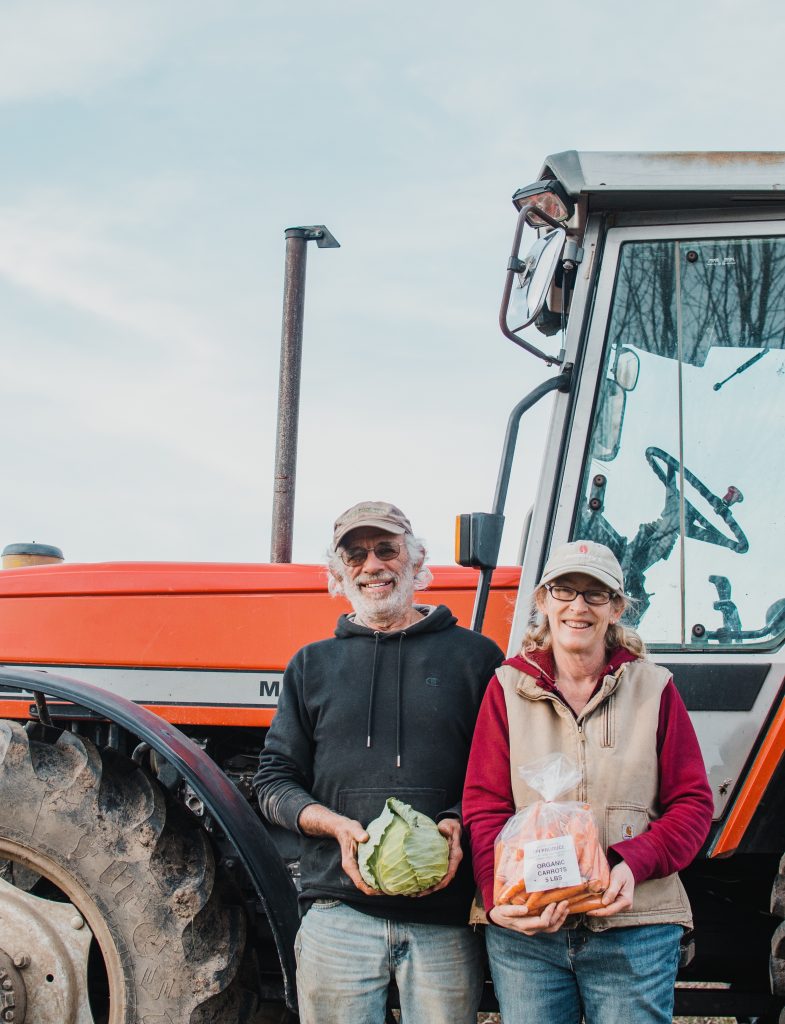
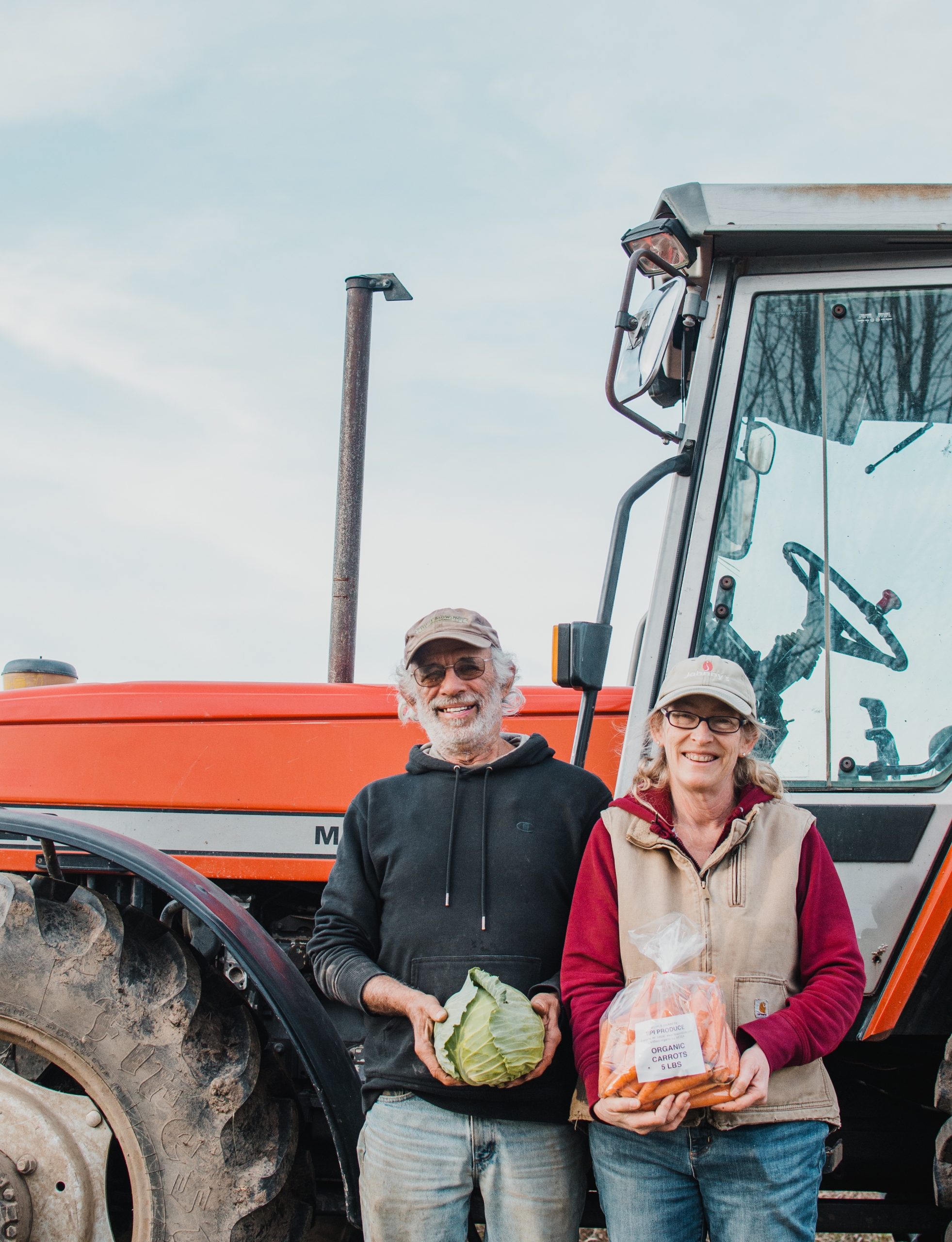
If you’ve purchased any amount of fresh produce from Willy Street Co-op in the past fifty years, chances are good that some of it was grown by Beth Kazmar and Steve Pincus of Tipi Produce.
From the first spring rhubarb to the last winter carrot—and many crops in between—Tipi’s high quality, affordable produce has been a foundation of the Co-op’s Produce departments for almost as long as the stores have existed.
You might even say we grew up together.
Season by season, pepper by pepper, melon by melon, the two businesses worked together to build both supply and demand for local organic produce in Dane County—and in the process helped build the unique, cooperative, and resilient community of farmers and eaters we have today.
2026 was the last year that Tipi Produce delivered to Willy Street Co-op’s stores. As Beth and Steve embark on a well deserved semi-retirement, this Eat Local Month we honor them and their legacy as we celebrate the thriving food community they were so instrumental in growing.
Nourishing the Community
Tipi’s story begins in the most unlikely of places: a row house in Philadelphia.
Growing up with parents who owned an elevator maintenance and repair business, Steve Pincus had almost no exposure to farming or even gardening as a child—though his early life did give him skills that proved invaluable later on. “My parents were always talking about business,” he remembers, “and I learned the ins and outs of having employees.”
He also became an excellent mechanic, a skill which he enjoys to this day.
It wasn’t until the early 1970s when Steve, now in his 20s and living in Milwaukee, started thinking about growing food. He was part of the group that started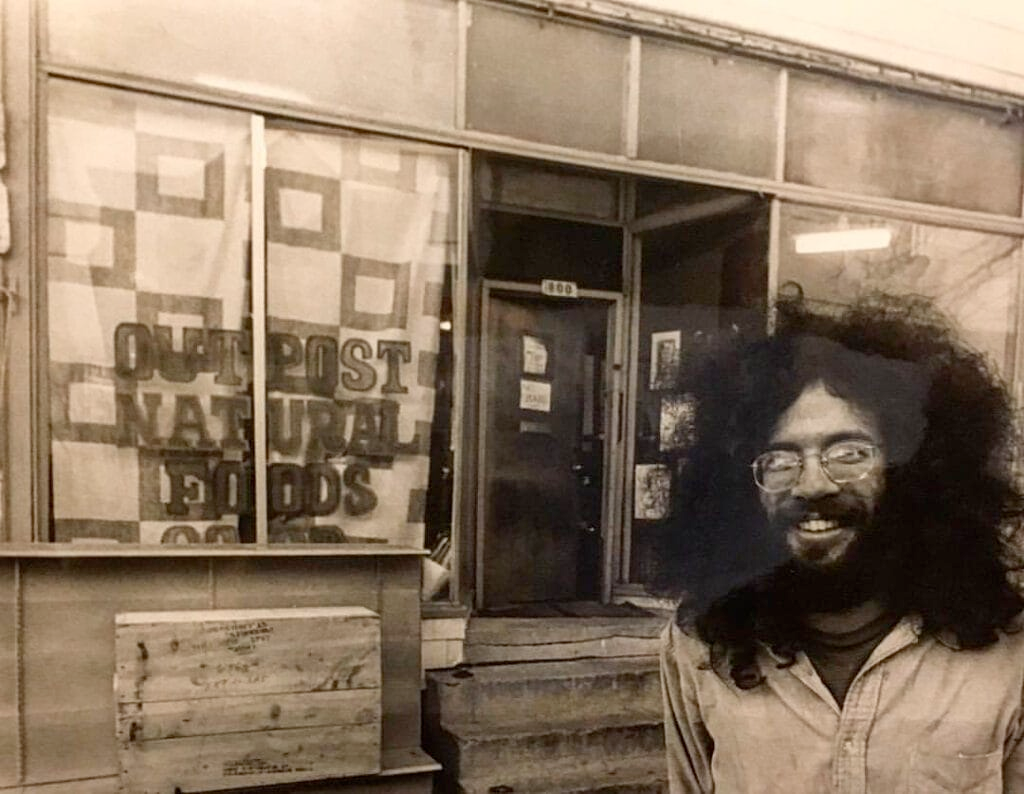 Outpost Natural Foods Co-op in that city, and in the process of setting up the new co-op, he struggled to find enough organic produce to meet Outpost owners’ needs. For while there were a few large conventional vegetable operations in the area, there were almost no small or mid-sized organic farms.
At the same time, new markets were emerging in Madison. The Dane County Farmers’ Market started in 1972, and a few food co-ops popped up, all—like Outpost—in search of nourishing, organic food.
So, in 1976, armed with a desire to feed his community, a strong work ethic and the mechanical and business skills he’d learned as a child (but with no farming experience to speak of), Steve began growing vegetables on five acres in Crawford County.
“I had no idea what I was doing,” he told me. “I just worked hard.”
The farm, on a ridgetop in Wisconsin’s Driftless region, was less than suitable for vegetable production. But Steve kept at it, focusing his efforts on supplying the growing food co-ops in southern Wisconsin, while also selling directly to customers at farmers’ markets.
In the mid-1980s, Steve left the farm in Crawford County for rented land in Fitchburg. This move both put him closer to the markets he served, and allowed him to pursue a degree in horticulture—not for the degree itself, but for the knowledge that came with it. “It really made a difference, being able to connect what was going on in the fields with what I was learning,” he explained.
In 1988, when their daughter was born, Steve’s wife Beth—a plant pathologist and research assistant at UW Madison—joined the farm full-time. An excellent organizer, Beth began a CSA (Community Supported Agriculture) program on the farm, which would eventually grow to supply half of the farm’s income.
With the demands of a family and the rapid growth of Madison-area CSA and wholesale markets in the early 1990s, Steve and Beth made the decision to stop going to farmers’ markets and focus instead on refining their half wholesale/half CSA model, putting equal emphasis on efficiency, scale, good employment practices and certified organic farming.
With their combined skills and dedication to hard work, they built something truly special.
For many years, Tipi packed 500 CSA boxes and delivered tens of thousands of pounds of organic produce to local co-ops and grocers. They offered year round employment to their core staff, and set the standard for what a wholesale organic vegetable farm can be in southern Wisconsin.
They also dedicated themselves to supporting and teaching other farms—presenting at conferences, taking on mentees, and helping spread knowledge in whatever way they could.
“Tipi’s legacy is huge,” said Andy Johnston, Willy Street Co-op’s Produce Category Manager, who has known Steve and Beth since he started at the Co-op in the early 1990s. “They were one of the first small organic vegetable farms to really show that ‘hey, we can grow food here,’ and they became a wholesale farm to grocers at a time when other farms just weren’t doing that.”
“Once they took local organics to the wholesale level, consumer demand increased, which opened up opportunities for other farms,” he said. “They were the spark behind it all, at least in southern Wisconsin.”
 More than just Fruits and Veggies
I spoke with several of the myriad farmers who’ve known Steve and Beth over the years, and the more we talked, the more it became clear that fruit and vegetable production is only one part of Tipi’s legacy—and perhaps not even the most important.
Cassie Wyss worked part-time for Steve and Beth in the early 2000s before teaming up with her then-husband, Michael Noltner to start Crossroads Community Farm, which has now grown to be a core supplier of the Willy Street Co-op Produce departments.
Though her time at Tipi was brief, Cassie still remembers how impressed she was with the work ethic that Steve and Beth both exemplified, and the importance they put on scale and efficiency.
“They’re the OGs”, she told me, “They pioneered wholesale, and showed that local farmers can do this at scale. Even now, twenty-some years later, I’m the fastest kale harvester at our farm. That’s because I was on Tipi’s kale team.”
Cassie also credits her time as an employee at Tipi with insights that later helped her become a good farm manager herself.
“Steve’s kindness was incredible,” she told me. “When he got frustrated, he would throw his hat on the ground, not turn it toward humans. This made it enjoyable to work for him, and that stuck with me.”
As she grew into her new role as farmer at Crossroads, Cassie appreciated the example that Beth—now a colleague instead of an employer—set as a married woman who was co-equal owner and manager of her farm.
“Most people think the farmer is the guy who drives the tractor. The woman becomes invisible,” Cassie said. She struggled with this dynamic, and watching Beth deal with the same thing and talk about it openly within the farming community opened space for Cassie and other female farmers to talk about it too, and understand that they weren’t alone. In turn, Beth credited other women pioneers in the Wisconsin organic farming community. “Dynamic women led the early work to start the organic farming conference and FairShare CSA Coalition.Their early efforts truly shaped our farming community and encouraged a culture of sharing.”
When I asked what she saw as Tipi’s biggest legacy, Cassie didn’t hesitate.
“They’re so passionate about teaching and sharing information,” she said, “That’s their legacy. ‘Yes, we can do it, but we’re also going to create a community of sharing that can actually feed the people.’”
This sharing of knowledge and expertise is the thing that stuck with David Bachhuber of Lovefood Farm, who was matched with Steve through a mentorship program put on by MOSES (Midwest Organic and Sustainable Education Service).
“I felt like I won the lottery when I was matched with him,” David says. “Steve’s wealth of knowledge is wild. Everything from microbiotics and seed culture to where to sell and changes in weather patterns.”
But the best thing about the mentorship, David told me, was not the knowledge itself but the generosity with which it was shared.” He’s so busy, I was reluctant to bother him. But he kept urging me to call—like every day.”
To Beth and Steve, this generous sharing of knowledge, and supportive, cooperative mindset comes naturally. When I asked them about it, they seemed surprised that it could even be a question.
“I needed so much help at the beginning,” Steve offered. “There wasn’t any question about sharing information. It’s not as if we have any trade secrets, we’re just muddling through like everyone else.”
Of course, as simple as that sounds, it’s not the way of many other businesses.
“They could just as easily not shared what they were doing,” Cassie pointed out. “That’s how most businesses operate. But that’s not what they did. Instead, they said, ‘Let us show you how. Let us teach you,’ and created the cooperative culture within the farms that serve Madison today.”
It’s this cooperative landscape—the network of farmers and eaters working together to grow a supportive, collaborative food system intended to nourish the community—that is perhaps Tipi Produce’s biggest legacy.
Vision for the Future
In 2025, Beth and Steve’s youngest child graduated from college, a milestone that they’d planned as their time to step back from large scale farming and enter what they’re calling semi-retirement.
Perhaps it should come as no surprise that they approached the process of scaling back in the same cooperative, community-focused way they’ve approached all other facets of their farming career.
Given the huge amount of produce coming from Tipi—especially crops like carrots and watermelon that require a good amount of growing expertise, storage space, and harvesting infrastructure—it would have been nearly impossible for any other local farm to simply take up these crops for the Willy Street Co-op stores from one year to the next.
So, Steve and Beth pursued a three-year downsizing plan specifically meant to give Willy Street Co-op sufficient time to work with next-generation farmers and increase production gradually to fill the gaps.
“They started with cucumbers and zucchini, then greens and muskmelon,” Andy Johston tells me. “It fell into place easily because of the gradual approach.”
Though they kept growing carrots—their most beloved crop—until the end, Tipi cut out summer carrots in 2023, which gave the Co-op a chance to ease a newer farm, Driftless Organics, into large-scale production
Though they’ve stopped selling wholesale and packing regular CSA boxes this year, Beth and Steve haven’t stopped farming completely, nor have they stopped serving the community.
“We have a devoted CSA community, and we didn’t want to see that end,” Beth explains. To continue serving these eaters, and others, Steve and Beth are growing and offering U-pick organic strawberries and plum tomatoes on their farm in Evansville.
For more information and to sign up for updates, visit www.tipiproduce.com.