
Meat


Find local, sustainable, and grass-fed options in our Meat departments.
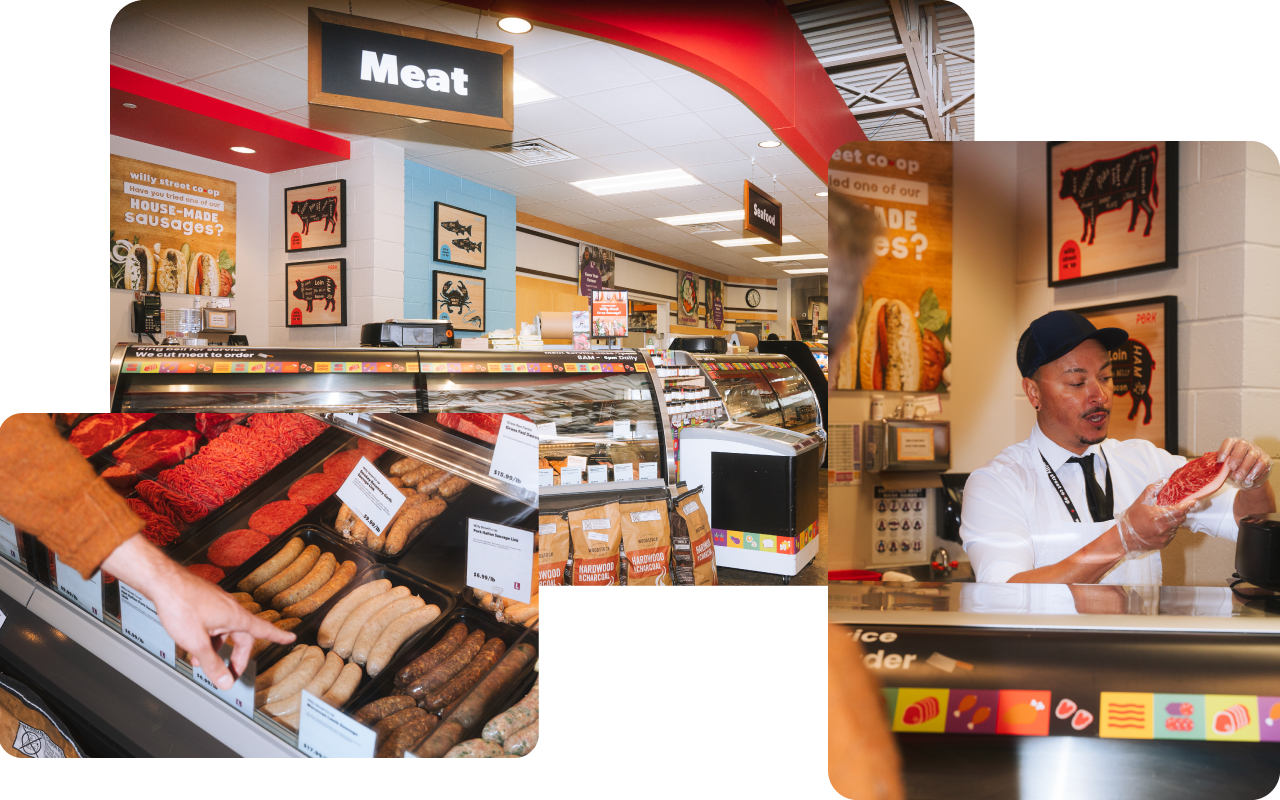
Meat counter

We partner with local and regional family farmers to source the highest quality, most ethical, and environmentally sustainable meat we can find. Whether you’re looking for pastured heritage pork, grass-fed beef, or organic chicken, you will find what you seek in our meat departments.

Looking for something specific? We’re happy to help with special orders! Just ask a Meat department staff member in-store or give us a call.
Local

Local

At Willy Street Co-op, our Meat departments feature a wide variety of local options because supporting nearby farmers means fresher products for you, a stronger local food economy, and fewer miles from farm to table.

Sustainable

Sustainable

We prioritize sustainably raised options—sourced from farms that care for the land, respect animal welfare, and help ensure a healthier food system for future generations.

Grass-Fed

Grass-Fed

We also feature a variety of grass-fed options, offering high-quality meat that’s rich in flavor while supporting farming practices that nurture soil health and animal well-being.

Our Standards

In order to meet increasing demand while keeping costs down, the meat industry has developed a large-scale factory farm approach to raising animals, which has negative implications for animal welfare, the environment, and human health. Willy Street Co-op prioritizes offering meat products with high standards for good taste, cleanliness, and animal well-being. In many cases our staff members personally visit the farms and processing facilities in order to evaluate humane treatment and sanitation techniques and to confirm a careful selection of the finished product. In our store we strive to carry a variety of meat and poultry products that meet the following criteria:

  • Free from added hormones and antibiotics.
  • Raised in clean and humane conditions, receiving adequate fresh air and space to move freely.
  • Fed food that does not contain animal by-products.
  • Raised on small-scale family farms that follow sustainable and environmentally friendly practices.
  • Certified Organic and/or grass-fed options available whenever possible.

Don’t hesitate to ask questions if you are concerned about the condition of the farms or the quality of the meats! A reputable seller welcomes inquiries about its products.


Meat Glossary

Organic meat and poultry
U.S. Department of Agriculture (USDA) Certified Organic meat and poultry meet strict requirements designed to promote animal health and wellbeing. These animals are raised without the use of antibiotics or growth hormones and must be fed 100% organic feed, with cattle receiving at least 30% of their diet from pasture. All animals must have regular access to the outdoors. Irradiation is not allowed for organic meat and poultry.
Grass-fed beef
In order to meet USDA claim standards for grassfed beef, cattle must be fed a diet exclusively of forage crops such as grasses and brassicas during the growing season, and hay and grain-free silage when forage is unavailable (winter). Grass-fed meats and poultry are higher in omega-3 essential fatty acids (EFAs) and generally leaner than grain-fed alternatives.
Free-range or free-roaming poultry
To label poultry as free-range or free-roaming, the USDA requires that animals have access to the outdoors. It does not specify for how long or for what percentage of the day. All USDA regulations around free-range and free-roaming apply exclusively to poultry.
Pasture-raised
Pasture-raised is an unregulated term that producers use to refer to animals that enjoy unrestricted access to the outdoors. The term was developed in part to distinguish the difference between free-range as the USDA defines it and the more liberal access to pasture some small-scale producers allow their animals.
All-natural
The USDA defines “natural” as minimally processed and/or without artificial ingredients. The label must specify which it is.
Antibiotic-free
A major source of antibiotic overuse is through livestock production, as up to 70% of antibiotics used in the U.S. are routinely given to chickens, pigs, and cattle. The administration of these antibiotics is largely necessary due to factory farming, a practice which creates an environment wherein it is difficult to maintain the health of animals. Animals raised under healthier conditions do not need routine (daily) administration of antibiotics. The USDA allows beef to be labeled as “antibiotic-free” only if sufficient documentation is available to prove the claim.
Growth hormones
According to the FDA, natural and synthetic hormones are routinely administered to beef cattle to promote rapid growth and lean meat. Steroidal hormones are not permitted for use in any animals other than beef and dairy cattle. Recombinant bovine growth hormone, or rBGH, is a nonsteroidal hormone used on dairy cattle that is legal for use in the U.S. but is banned in the European Union and Canada, among other countries.
Nitrates and nitrites
These chemical compounds are a normal part of the diet and are even found in some vegetables, such as celery and spinach. Processed meat products often contain synthetic sodium nitrate and potassium nitrite as preservatives. Although some studies have potentially linked nitrates and nitrites to certain types of cancer, they are not currently classified as carcinogenic by the Centers for Disease Control and Prevention (CDC).

SIGN UP FOR OUR DIGITAL READER

Digital Reader Sign Up

This field is for validation purposes and should be left unchanged.